If the water were clear enough,
if the water were still,
but the water is not clear,
the water is not still,
you would see yourself,
slipped out of your skin,
nosing upstream,
slapping, thrashing,
tumbling
over the rocks
till you paint them
with your belly’s blood:
Finned Ego,
yard of muscle that coils,
uncoils.
If the knowledge were given you,
but it is not given,
for the membrane is clouded
with self-deceptions
and the iridescent image swims
through a mirror that flows,
you would surprise yourself
in that other flesh
heavy with milt,
bruised, battering toward the dam
that lips the orgiastic pool.
Come. Bathe in these waters.
Increase and die.
If the power were granted you
to break out of your cells,
but the imagination fails
and the doors of the senses close
on the child within,
you would dare to be changed,
as you are changing now,
into the shape you dread
beyond the merely human.
A dry fire eats you.
Fat drips from your bones.
The flutes of your gills discolor.
You have become a ship for parasites.
The great clock of your life
is slowing down,
and the small clocks run wild.
For this you were born.
You have cried to the wind
and heard the wind’s reply:
“I did not choose the way,
the way chose me.”
You have tasted the fire on your tongue
till it is swollen black
with a prophetic joy:
“Burn with me!
The only music is time,
the only dance is love.”
If the heart were pure enough,
but it is not pure,
you would admit
that nothing compels you
any more, nothing
at all abides,
but nostalgia and desire,
the two-way ladder
between heaven and hell.
On the threshold
of the last mystery,
at the brute absolute hour,
you have looked into the eyes
of your creature self,
which are glazed with madness,
and you say
he is not broken but endures,
limber and firm
in the state of his shining,
forever inheriting his salt kingdom,
from which he is banished
forever.
by Stanley Kunitz
This poem defies the rational mind that wants a nicely packaged meaning, yet it still communicates with great emotional impact. Something about Stanley Kunitz’s difficult and yet luminous life, which you can read about here, seems to magnify the poem’s voice.
On the first reading, I get a feeling that is hard to describe. It’s a recognition of some deep truth that I can’t name. It feels like a pushing in my heart, a swelling of pain and vibrant life force both at once. At the same time, another part of me wants to give up right away: This poem is too much. It’s utterly baffling, and trying to understand it is hopeless! this part is saying. At this point, there’s a good chance I could give up on it, but something keeps drawing me back. It’s the contradictory refrain:
If the water were clear enough,
if the water were still,
but the water is not clear,
the water is not still…
and later:
If the heart were pure enough,
but it is not pure…
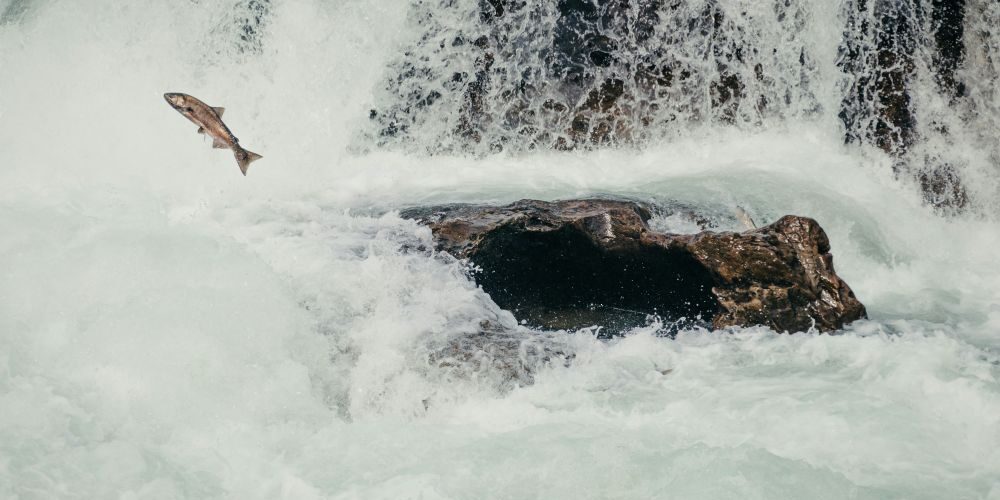
that has hooked me. I sense that this evokes both the tragedy and the spiritual wonder of the human experience, encapsulated and given form in the metaphor of a salmon in the river of life. It is struggling and deceiving itself, yet enduring and increasing, while always also dying. Then, finally, shining, inheriting the ‘salt kingdom’, and in the same instant being banished from it.
Our most heartbreaking efforts to live a wonderful life may be rooted in blindness, wishful thinking, and ‘if only’. In Buddhism, this is an example of ignorance, which is living in delusion, divorced from a wise understanding of reality. We think over and over: If the water were clear enough, then I’d be… If the heart were pure enough, then maybe… If, if, if. This unseeing reaching is so definitive of us humans, and so tragi-beautiful. It keeps us stuck on the one hand, yet tirelessly searching and valiantly trying to self-realise on the other.
It strikes me that a salmon has the mind-blowing power to swim upstream. Similarly, we push forward in life with heroic effort, despite the odds being stacked against us – we’re so imperfect, there’s so much complexity, life hurts. And then it all ends. In the poem, we enter deeply into this ‘if’, we’re catapulted into ‘but it is not’ and then where do we end up?
I find myself in a mixture of awe and compassion at the grand, wild, crazy torment of it all. It seems like a mean trick, and yet there is the ‘state of shining’, the great inheritance, and the incandescent moment when you ‘have looked into the eyes of your creature self, which are glazed with madness’ and, finally, you SEE. What an image! What a journey! Phew!
PS. If you’d like to explore how poetry can be a living contemplation and an oasis of meaning in our overwhelming world, join us on the Mindfulness meet Mystical Poetry 6 week course. You will be guided to discover a wide range of mystical poetry of the past, present, east and west. With the help of mindfulness, you’ll find that poems speak to you, but perhaps not always in the way you thought they would.
Photo by Shana Van Roosbroek on Unsplash